
The Borrower Is Servant to the Lender, So Pick Your Master

🔲 Ownership vs. Leasing Is a Strategic Choice. The core message centers on control, tenants are always serving either a landlord or a lender. By planning ahead, business owners can transition from renting to owning, gaining equity, control over costs, and long-term financial advantage.
🔲 Most Tenants Overpay Due to Lack of Knowledge. Many commercial tenants don’t fully understand lease math or market rates. Paying $12/sq ft in a market where $8 to $10 is realistic shows how lack of negotiation and awareness leads to costly mistakes.
🔲 Building Credit Unlocks the Path to Ownership. Establishing strong business credit, especially a PAYDEX score above 70, is essential. Access to capital at a reasonable cost enables business owners to invest, expand, and ultimately purchase property.
🔲 Due Diligence Turns Tenants into Smart Buyers. A structured evaluation (electric, plumbing, HVAC, roof, structure, parking, signage) empowers tenants to identify true costs, negotiate effectively, and plan CapEx, making ownership a calculated move rather than a risky leap.
$12 a square foot for NWI retail?
Can we do better than that, please?
This building is so old… Who's gonna cover the improvements?
The borrower is servant to the lender. That's not my opinion, that's Proverbs 22:7. And if that's true, then you get to pick your master. Do you want to be a servant to the bank, or do you want to be a servant to a landlord?
Why not explore the possibility of becoming your own landlord, even if it took two years for you to graduate from tenant to owner? Can we start planning that now?
Meet Chad

I just met with a vibrant, young, enthusiastic entrepreneur named Chad. He's leasing a space, 6,000 square feet for six thousand dollars a month. Now, the math on that is pretty high for his space. I know it seems like six thousand equals six thousand, but the way commercial leases are figured is different.
6,000 dollars per month × 12 months = $72,000 per year ÷ 6,000 square feet = $12 per square foot.
So Chad's lease is twelve dollars per square foot. And that matters.
What Can You Get for Twelve Dollars in Northwest Indiana?
There's a lot of factors that go into what a fair lease rate looks like, but the number one factor is traffic. From a retailer's perspective, it's all about traffic, ease of access, parking, foot traffic, visibility. A commercial realtor would say "location," but that's from the realtor's vantage point. The retailer just cares about humans. We just want buyers to find us and get into the building to purchase our goods.
Is it easy to find? Can I get there? Can I find parking? Is it convenient? Is there good directional signage? Am I nearby other high-volume, high-traffic locations? Because people like to shop in clusters. Something in human nature wants to get all their shopping done in one trip, and people love to feel safe doing it.
Chad happens to be on the main strip in Whiting, which is 119th Street. He's in a 200-year-old building, which is phenomenal. And yes, it's decaying.
The Leap from Tenant to Owner

Chad's putting together a proposal to purchase the building. The landlord has put an outlandish price on the table, roughly 12 years of lease revenue, somewhere around $1.2 million. That's crazy. That's really crazy.
But here's what's crazier: Chad should not have signed a lease at $12 per square foot in the first place. That's super premium in today's market. If nobody else on the same street can get $10 per square foot for an even better property, why is he paying twelve when he could have negotiated down to eight? He didn't know what he was getting into. He didn't haggle. And that's a lesson for every commercial tenant reading this.
Why are you leasing when you could be putting yourself in the position to own?
Building Business Credit, Your PAYDEX Score

In order to become an owner, you have to build business credit, which is specifically different than personal credit. Your personal score might help you get rolling, but you have to properly establish your business entity and grow your PAYDEX score, also called your Dun & Bradstreet score.
You need to get it over 70. Ideally over 75. It's a fairly straightforward score between zero and 100, and it does take some effort and energy. But if you get your PAYDEX score north of 72, that opens up massive lines of credit for your company. And access to capital is access to the future.
People who are allergic to borrowing don't understand the power of access. As a business person, if I come in and give you $10,000, you have to be able to turn that $10,000 into a larger number. That's the essence of business. If I literally give you a dollar and you can't turn it into $1.20, then you're not in business.
There's a lot of different industries and a lot of different margins available, but typically, in order to compete, you have to have a cost of capital. Your access to capital needs to be high, and your cost of capital needs to be low. The fact that most tenants don't have the vision to think outside the box, to explore the possibility of ownership, is a sad state of the world in which we live.
How You Play Ball, The Due Diligence Checklist

Most tenants are not empowered to negotiate. They don't know how to come to the table ready to play ball. So here's how you play ball.
Step one: find problems. You're really good at that, because you live there. You know there's problems. You know it's going to take $50,000 to upgrade the electric to get it up to code. So you get a professional electrician to give you a proposal for what it would take to get your infrastructure up to speed once you're the owner. This is a necessary homework component, and it's not that difficult, because you're not doing the work. You're just making a couple phone calls and getting a commercial electrician in there to tell you the current state of your electric.
Once that's done, you put that proposal in a folder. You keep it. You smile. You sleep well. You breathe and you dream.
Then you call a plumber. "Hey, look, can I have you come look at the infrastructure of our plumbing to see if there's any necessary upgrades to get us to code? I don't want any backflows. I don't want any issues. I want to make sure that my velocity is solid." So once you have your plumbing estimate, let's say it's $15,000 to get your plumbing up to speed with all of your plans for the future, now you have your energy flow and your water flow for the building solidified.
The Building Envelope

Then you talk about the building envelope. You examine the outer walls. Take a walk around the building and determine whether these walls are strong or at risk. Get a brick mason out there for a tuckpointing quote, or get a structural analysis from an engineer to see what the building integrity looks like, the walls and the trusses.
It's vitally important that the roof be part of your evaluation, because what are the walls for if not to support the roof? That's part of their job, to hold up the top. A building without a top is incomplete.
You need a sidewall and roof evaluation on the underneath, for sure, including the vapor barrier, including the ceiling tiles, all of it. A structural analysis of the total envelope: exterior, interior, the bones of the building.
The Roof Is an Interesting Monster
Most people only think about the top, but the roof actually has a ceiling. You want every layer evaluated from the inside ceiling up to the decking. Is there a vapor barrier on the inside, or did they forget that during the original structural engineering? And what kind of insulation are we talking about?
A roof without insulation is like a person without a coat. There's at least two seasons out of the year, probably three, where a human wants to wear a coat. It was 30 degrees today at the end of March. Great day for a hoodie. Some days you want a full winter coat. Sometimes a Fall sweater. If a human wants to wear a coat three seasons out of the year, why can't the building wear a coat?
Plus, you've got this massive company called NIPSCO, and they keep trying to bite a large chunk of your profit and consume your energy, both physically and financially. So we've got to protect the building. We've got to put a coat on it. Thickness. Layers of insulation. An outside wrap.
Four Items on the Menu
After you've got your electric proposal, your plumbing proposal, and your structural analysis of the walls and roof, then you call in your roofer. We're going to give you four layers of options.
First, there's patch it up, preventative maintenance, basic band-aids just to get you by until you have full ownership within a couple of years.
Second, there's Conklin liquid seamless coating. Kind of like a big bathtub, edge to edge, all white, super thick. No seams. Up to a 20-year warranty.
Third, there's the overlay, where we add 1.5 to 5 inches of thick, rigid, walkable insulation layers using FLEXION vinyl, and then add a liquid coat over that insulation. This roof helps pay for itself because your NIPSCO bill drops significantly, 25% to 40%.
And then there's the last option that nobody wants, which typically comes from total neglect and abandonment: complete removal. You're paying for demolition and dumpsters. Roughly a dollar per square foot for tear-off labor, and dumpsters run about $600 each, usually several of them. So just take your roof square footage, multiply by a dollar, and that's your labor. We're trying to avoid that if at all possible, because in Hammond, Portage, Hobart, everywhere across NWI, you can legally have two roofs. We always want to explore the cheaper options first.
✉️ Is your building the one you’re going to own someday?
Subject Property Address: ___________________________
Drop the address and we'll take a look at what it would actually cost to get that roof, and that building, ready for ownership.
[ Email address ] → [ Send Me the Real Stuff ]
HVAC, Parking, and the Stuff Nobody Thinks About
Then you call your HVAC buddy and have him come out for a systems analysis. What would it take to upgrade your efficiency? What does your airflow look like in the building? Because air is part of your life. Our blood needs oxygen. You don't want dew and moisture flowing through the air. You don't want stench and rot in your customers' lungs. And your workers, you have to treasure them and protect their environment.
HVAC and roofing actually work best together. When they're doing the upgrade, we build out a fresh elevation, 10 inches tall, so that all of your rooftop units are up on curbs or platforms, and you don't have any standing snow load confusion. It's very common for people to prioritize HVAC repair over the roof, and that's fine. Let's get the HVAC squared away, and then let's do the roof at the same time.
Your parking lot is another major consideration in the due diligence. And that's really your big structural picture, electric, plumbing, HVAC, walls, ceiling and roof, structurally and covering, and then the parking lot.
The Assumption of Brilliance
You'd be amazed how retailers assume that consumers are brilliant. Most of us in the normal world need very clear directional signage for how to get into the building. It's hilarious, actually. We need arrows. "Enter Here." I'm driving past a hospital right now and there's big arrows , "Main Entrance Right Here."
People don't think they want clear directions, but they do. They drive around and around and around the building, and you're like, "How could you not find the entrance?" And they're like, "Well, I'm just not familiar, so I drove right past it."
Signage is a very undervalued portion of investment because of the assumption of brilliance. Being convenient is powerful.
Ownership Doesn't Require Capital, It Requires a Return on Capital
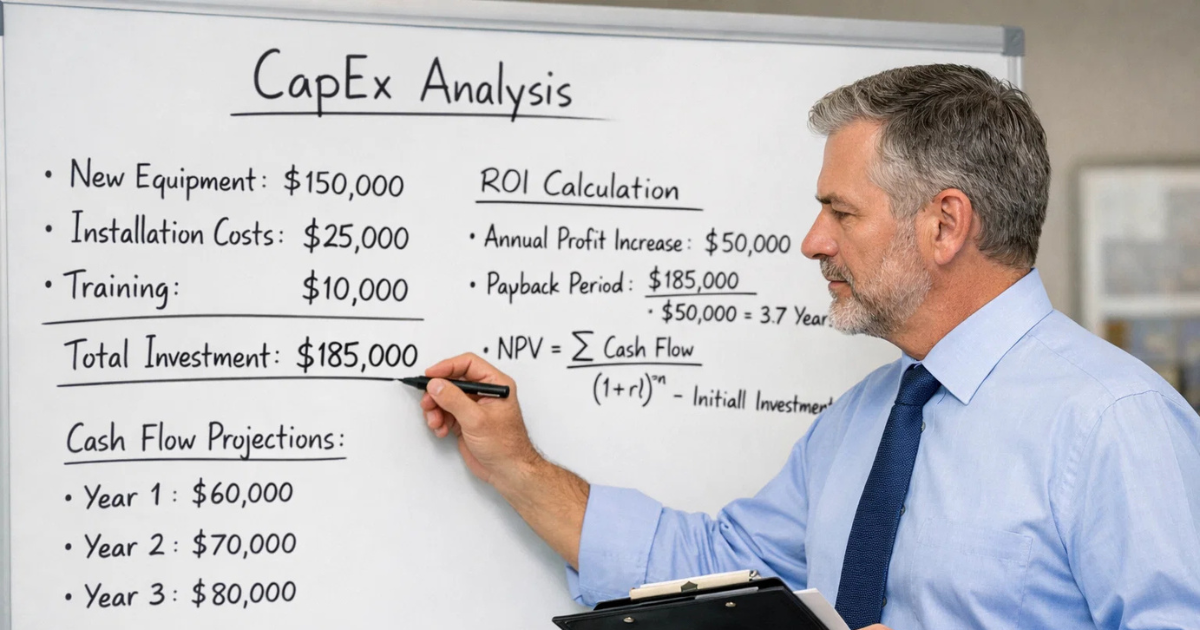
Ownership doesn't require capital. It requires calculating a return on capital. If your cost of capital is under 10% and your company is producing a gross margin above 30%, then you should be safe, because every one of your competitors, or the vast majority of them, are paying a cost of capital. They all have lines. We're not just talking credit cards. We're talking lines of access to money to make things happen, for equipment, manpower, and especially structure.
Capital expenditures are typically shortened into this wonderful word that you will say at least a thousand times as an owner, CapEx.
CapEx is what you put into the building structure itself, paint, updates, décor, parking lot, the roof, all of it.
Home improvement stores are open for a reason, buildings keep unimproving themselves. Every building decays and degrades, and it needs constant upkeep. So planning these things and having some kind of structure, instead of just being reactive and waiting for structural anomalies to smash you in the face with surprises, is how owners think.
The easiest explanation is a vehicle. There's always a cost of maintenance. You can't pretend that your tires are eternal or that no oil changes will ever be needed. Every part in the vehicle needs to be on a timer, a range, and there's got to be a little bit of CapEx set aside for vehicle endurance. Your building is no different.
Your Next Move
If your cost of capital is under 10% and your margins are above 30%, you're already in the zone. The question is whether you've actually done the math. Most tenants haven't. Most tenants don't even know what their cost of capital looks like, let alone how SBA loans, PAYDEX scores, and business credit lines stack up against each other.
We built a Cost of Capital Analysis to help you start thinking like an owner, even if you're still a tenant today. It walks you through where to find your numbers, how to compare your options, and what the path from tenant to landlord actually looks like over 24 months.
✉️ Start doing the math on ownership. Even if it takes two years, the plan starts now.
Subject Property Address: ___________________________
Drop the address and we'll take a look at what it would actually cost to get that roof, and that building, ready for ownership.
[ Email address ] → [ Send Me the Real Stuff ]
➔ Download: Cost of Capital Analysis for Commercial Tenants
Start doing the math on ownership. Even if it takes two years, the plan starts now.
PristineIndustrialRoofing.com/cost-of-capital
Read other blog:


We Love Conversations
 SoHelpful@PristineIndustrialRoofing.com